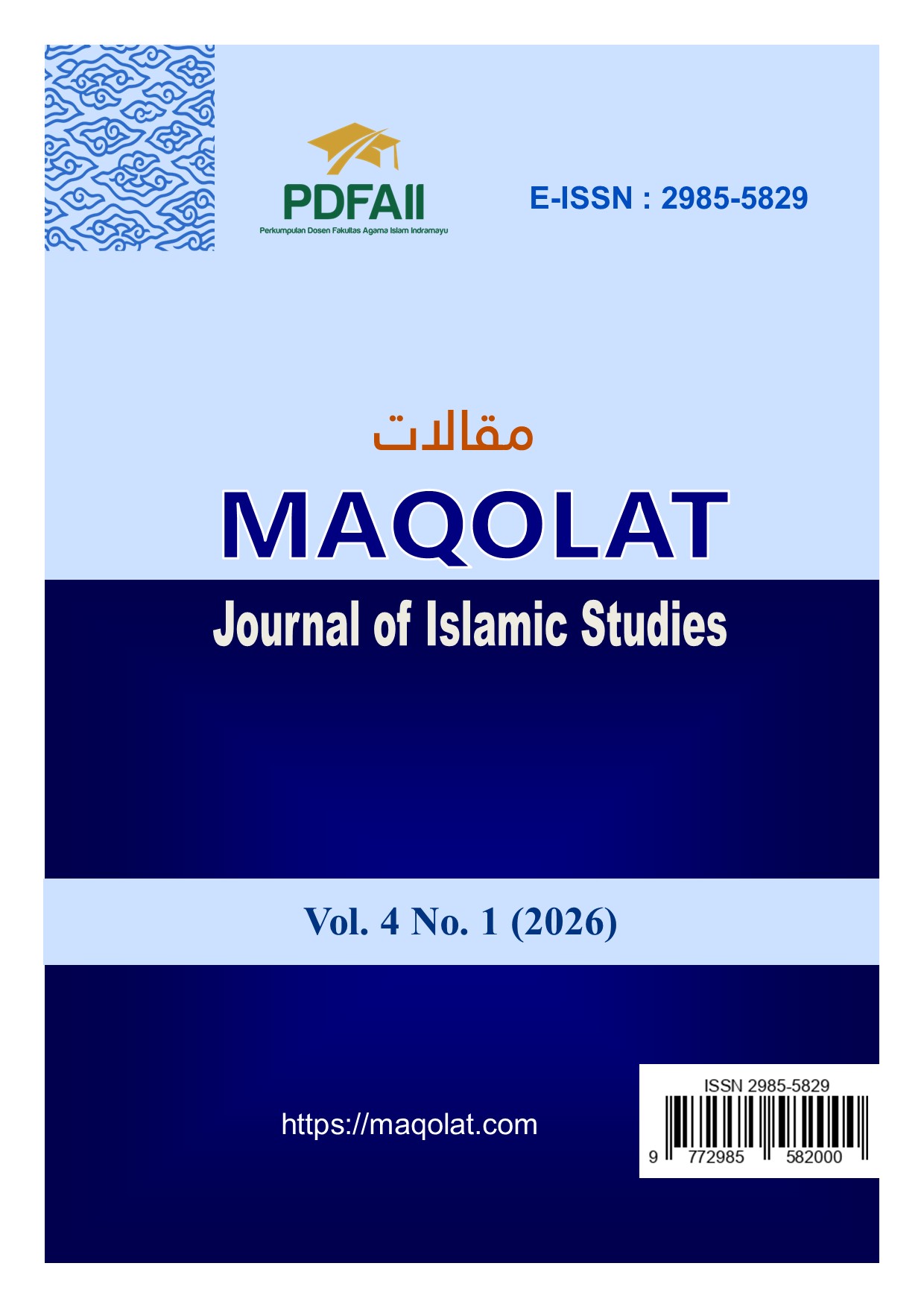
Influence Of Islamic Ethical Teachings On Civic Responsibility And Social Behaviour Among Secondary School Students In Gusau Metropolis, Zamfara State, Nigeria
DOI:
https://doi.org/10.58355/maqolat.v4i1.214Keywords:
Civic responsibility, Gusau Metropolis, Islamic ethics, Moral education, Social behaviour.Abstract
This study examined the influence of Islamic ethical teachings on civic responsibility and social behaviour among secondary school students in Gusau Metropolis, Zamfara State, Nigeria. The research was prompted by increasing moral decline and civic irresponsibility among youths despite formal instruction in Islamic Religious Studies. Anchored on Bandura’s Social Learning Theory, the study adopted a descriptive survey design involving 357 Senior Secondary School Three (SS III) students selected through a multistage sampling procedure from public and private schools. Data were collected using a validated questionnaire titled Islamic Ethical Teachings, Civic Responsibility and Social Behaviour Questionnaire (IETCRSBQ), with a reliability coefficient of 0.91. Descriptive and inferential statistics, including Pearson correlation and independent t-test, were employed for data analysis at a 0.05 significance level. Findings revealed a significant positive relationship between Islamic ethical teachings and students’ civic responsibility and social behaviour. Students exposed to Islamic moral values demonstrated higher levels of discipline, honesty, tolerance, and respect for societal norms. However, the study identified challenges such as inadequate teacher preparation and weak moral supervision in schools. It concluded that the consistent integration of Islamic ethical principles into civic education enhances students’ moral character and civic engagement. The study recommended teacher capacity building, curriculum reinforcement, and the promotion of Islamic moral clubs to foster responsible citizenship and harmonious coexistence among students.
Downloads
References
Adebayo, K. T., & Yusuf, R. A. (2022). Civic education and moral regeneration in contemporary Nigeria. African Journal of Social and Behavioural Studies, 14(1), 33–48.
Abubakar, M. A., & Sani, L. M. (2023). Moral education and civic responsibility in Nigerian secondary schools: Challenges and prospects. Journal of Educational Values and Society, 8(2), 45–59.
Abubakar, M. L., & Sani, A. H. (2023). Challenges of moral and civic education in Nigerian public secondary schools: Implications for ethical reform. Journal of Educational and Moral Studies, 18(2), 112–128.
Abubakar, M., & Sani, A. (2023). Barriers to moral and civic education in northern Nigerian schools: Implications for Islamic teaching integration. Journal of Educational Reform and Practice, 8(2), 55–68.
Bandura, A. (1977). Social learning theory. Prentice Hall.
Hassan, A., & Ahmad, I. (2021). Islamic moral education and social behaviour among Nigerian secondary school students. Journal of Moral and Civic Studies, 9(3), 40–52.
Hassan, A., & Ahmad, I. (2021). Moral and civic education in Islamic perspective: A tool for peace and social integration in Nigeria. Journal of Islamic Studies and Education, 9(2), 56–68.
Hassan, M. I., & Ahmad, Z. (2021). Islamic education and youth moral reformation: Implications for civic peace and national integration. International Journal of Islamic Pedagogy, 9(3), 112–126.
Hassan, T. A., & Ahmad, S. M. (2021). Islamic ethical instruction and students’ social behaviour in secondary education. African Journal of Moral and Civic Education, 9(1), 44–58.
Ibrahim, H., & Yusuf, A. (2022). Societal influences and the challenges of integrating Islamic ethics in civic education. International Journal of Social and Educational Studies, 10(1), 76–89.
Kamal, A., & Ibrahim, H. (2021). Islamic moral values and the promotion of civic responsibility among Muslim youths. International Journal of Ethics and Social Development, 7(1), 44–58.
Kamal, A., & Ibrahim, U. (2021). The role of Islamic values in promoting civic responsibility among Nigerian youths. Journal of Islamic Pedagogy and Social Development, 7(3), 90–105.
Kamal, N., & Ibrahim, H. (2021). The role of Islamic ethical values in promoting civic behaviour among Muslim youth. Journal of Islamic Civilization and Contemporary Studies, 7(2), 25–41.
Musa, K. Y., & Idris, B. (2022). Integrating moral instruction in private and public secondary schools in Northern Nigeria. Educational Research and Review, 15(4), 220–234.
Musa, M., & Abdullahi, L. (2022). Impact of Islamic moral teachings on civic consciousness among Muslim youths in northern Nigeria. Journal of Religion and Social Development, 7(2), 25–38.
Nuhu, A. (2024). Re-evaluating moral instruction in Nigerian secondary schools: A critical analysis of teacher practice and student outcomes. International Journal of Contemporary Educational Research, 12(1), 55–72.
Nuhu, A. M. (2024). Social media influence and moral decline among adolescents in Northern Nigeria. Journal of Adolescent Behaviour and Ethics, 12(1), 14–28.
Rahman, A., & Salisu, M. (2023). The role of Islamic ethics in shaping moral and civic consciousness among learners. Journal of Religious and Moral Education, 11(3), 22–35.
Rahman, A., & Salisu, M. (2023). The role of Islamic ethics in shaping moral and civic consciousness among learners. Journal of Religious and Moral Education, 11(3), 22–35.
Rahman, M., & Salisu, I. (2023). Islamic ethics and civic responsibility: Educational implications for youth development in Nigeria. Journal of Religious and Ethical Education, 6(2), 75–89.
Rahman, T., & Salisu, A. A. (2023). Islamic ethics and social responsibility in the 21st-century classroom. Journal of Religious and Moral Education, 11(2), 65–80.
Research Advisors. (2006). Sample size table. The Research Advisors. http://www.research-advisors.com/tools/SampleSize.htm
Usman, A., & Abdullahi, R. (2022). The impact of Islamic moral principles on student behaviour and civic engagement in secondary schools. Nigerian Journal of Educational Foundations, 10(2), 101–117.
Usman, I., & Garba, U. (2022). Influence of Islamic moral instruction on students’ discipline and social behaviour in secondary schools. Journal of Islamic Education and Psychology, 6(1), 65–79.
Usman, L., & Abdullahi, M. (2022). Civic obligations and moral responsibility in Islamic education. African Journal of Civic and Moral Studies, 10(1), 70–83.
Usman, L., & Abdullahi, M. (2022). Civic obligations and moral responsibility in Islamic education. African Journal of Civic and Moral Studies, 10(1), 70–83.
Usman, S. M., & Abdullahi, A. (2022). Integrating Islamic moral education and civic learning for value reorientation among secondary school students in Nigeria. Journal of Educational Research and Islamic Studies, 10(4), 77–92.
Yusuf, L. A., & Bello, I. T. (2021). Civic education and moral transformation in contemporary Islamic schools. Journal of Values and Citizenship Studies, 5(2), 64–78.
Downloads
Published
How to Cite
Issue
Section
License
Copyright (c) 2026 Sule Muhammad

This work is licensed under a Creative Commons Attribution 4.0 International License.