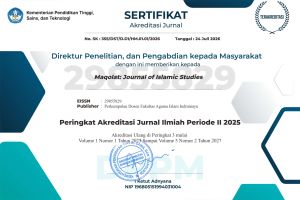
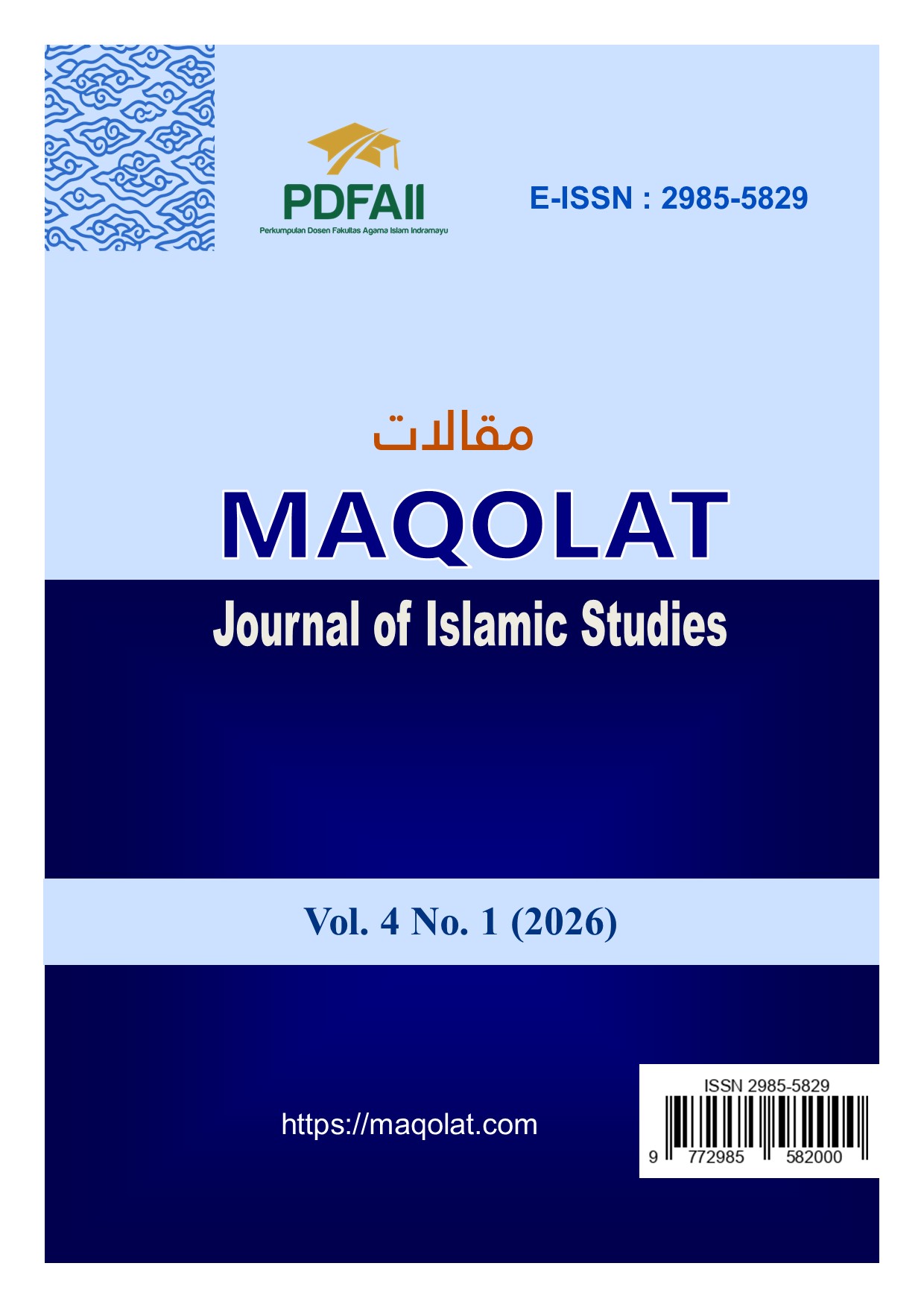
Unravelling The Mysteries Of Microorganisms In The Qur’an
DOI:
https://doi.org/10.58355/maqolat.v4i1.219Keywords:
Qur’an, Microorganisms, Microbes, Infectious Diseases.Abstract
Over centuries, microorganisms have puzzled microbiologists due to their wonders. This descriptive qualitative study adopted Thematic Approach and Synoptic Approach to unravel how Qur'an allude to these wonders. Tafsir Ibn Kathir was used for preliminary interpretation of identified verses. Data concerning wonders of microorganisms were screened from online databases. The preposition مِن (part of) used in the phrase لَا يَعْزُبُ عَنْهُ مِثْقَالُ ذَرَّةٍ فِي السَّمَاوَاتِ وَلَا فِي الْأَرْضِ وَلَا أَصْغَرُ مِن ذَٰلِكَ وَلَا أَكْبَرُ إِلَّا فِي كِتَابٍ مُّبِينٍ (not even the weight of a speck of dust or less than that or greater escapes His knowledge in the heavens or in the earth but it is in a Clear Book) of Qur’an, 61:10, as used in Qur’an, 34:3, allude that, even microorganisms and their tiniest particles that makes them, are within Allah’s knowledge. This modest contribution may help people to ponder on presence, greatness, and glory of Allah (S.W.T).
Downloads
References
Al-Jawi, M. bin U. N. (2006). Tafsir Marah Labid. Lebanon, Dar al- Kotob al-Ilmiyah.
Al-Osail, A. M., & Al-Wazzah, M. J. (2017). The history and epidemiology of Middle East respiratory syndrome corona virus. Multidisciplinary Respiratory Medicine, 12(1), 1–6. https://doi.org/10.1186/s40248-017-0101-8.
Alphey, L., McKemey, A., Nimmo, D., Oviedo, M. N., Lacroix, R., Matzen, K et al. (2013). Genetic control of Aedes mosquitoes. Pathogens and Global Health, 107(4):170-9. doi: 10.1179/2047773213Y.0000000095.
Asad, M. (1980). The Message of The Qur’ān, Dar al-Andalus: Gibraltar.
Atwa, A. A., Bilgrami, A. L., & Al-Saggaf, A. I. M. (2017). Host–parasite interaction and impact of mite infection on mosquito population. Revista Brasileira De Entemologia, 61:101-106.
Barns, S. Click on an image to view larger version & data in a new window Tree from Burggraf et al., 1997 Containing group: Crenarchaeota.
Cavaillon, J. M., & Legout, S. (2022). Louis Pasteur: between myth and reality. Biomolecules, 12(4), 596.
Dennison, N. J., Jupatanakul, N & Dimopoulus, G. (2014). The mosquito microbiota influences vector competence for human pathogens. Current Opinion in Insect Sciences, 3:6-13. Doi: 10.1016/j.cois.2014.07.004.
Fenner, F., Bachmann, P. A., Gibbs, E. P. J., Murphy, F. A., STUDDERT, M. J., & WHITE, D. O. (1987). Structure and Composition of Viruses. Veterinary Virology, 3.
Girard, M., Martin, E., Vallon, L., Ruguin, V., Bellet, C., Rozier, Y et al. (2021). Microorganisms Associated with Mosquito Oviposition Sites: Implications for Habitat Selection and Insect Life Histories. Microorganisms, 9(8):1589. Doi: 10.3390/microorganisms9081589.
Harris, S. D. (2008). Branching of fungal hyphae: regulation, mechanisms and comparison with other branching systems. Mycologia, 100(6), 823-832.
Ibn Kathir, I. (2000). Tafsir ibn Kathir. Riyadh: Dar-us-Salam.
International, S. (Ed). (2004). The Holy Qur’an, English Meanings. (S. International, Trans.). Al Muntada al Islam, Jeddah.
Kitota, A. M. (2023). Parasites and Microbes On the Bodies of Mosquitoes: A Systematic Review Based on the Tafsir of Surat Al-Baqarah, 2: 26 and Signs in Modern Medicine. Journal of Quranic Sciences and Research, 4(1), 16-20.
Kusumaningrum, K. D. A., Azizah, A & Nurrohim, A. (2022). Viruses and Plague in Al-Azhar's Tafsir: Correlation of Covid-19 Discovery with Alquran Verses. Advances in Social Science, Education and Humanities Research, 676.
Lalu, O., Nurul, M., & Nursyamsu, W. (2020). Tafsir Virus (Fauqa Ba’ūdhah: Korelasi Covid-19 Dengan Ayat-Ayat Allah. 63–84.
Levin, P. A., & Angert, E. R. (2015). Small but mighty: cell size and bacteria. Cold Spring Harbor perspectives in biology, 7(7), a019216.
Levine, R., & Evers, C. (1999). The slow death of spontaneous generation (1668-1859). Disponibile in rete all’indirizzo: http://www. accessexcellence. org/RC/AB/BC/Spontaneous_Generation. php.
Liang, J., & Williams, D. R. (1997). Aberrations and retinal image quality of the normal human eye. JOSA A, 14(11), 2873-2883.
Mahy, B. W. (2003). Dictionary of Microbiology and Molecular Biology, -Paul Singleton, Diana Sainsbury, Wiley, Chichester, 2001. 895 pp.; $150.00. Virus Research, 1(93), 123.
Majid, Z. A. (2021). Covid-19 Pandemic in the Quran Literature (Study of Interpretation Maudhu'I About Thaun in Islam). Jurnal Pendidikan Islam, 5(2).
Minard, G., Mavingui, P & Moro, C. V. (2013). Diversity and function of bacterial microbiota in the mosquito holobiont. Parasite & Vectors, 6:146.
Mponzi, W. P., Swai, J. K., Kaindoa, E. W., Kifungo, K., Eiras, A. E., Batista, E. P., ... & Okumu, F. O. (2022). Observing the distribution of mosquito bites on humans to inform personal protection measures against malaria and dengue vectors. PLoS One, 17(7), e0271833.
Mursyid, A. (2020). Tafsir Ayat-Ayat Pandemi: Studi Atas Fatwa Majelis Ulama Indonesia (MUI). Misykat, 05(1), 23–50.
Nester, E. W., Anderson, D. G., Roberts Jr, C. E., & Nester, M. T. (1995). Microbiology: A human perspective. (No Title).
Olagunju, E. A. (2022). Housefly: Common zoonotic diseases transmitted and control. Journal of Zoonotic Diseases, 6(1), 1-10.
Ryu, W. S. (2016). Molecular virology of human pathogenic viruses. Academic Press.
Sarwar, M. (2015). Insect vectors involving in mechanical transmission of human pathogens for serious diseases. International Journal of Bioinformatics and Biomedical Engineering, 1(3), 300-306.
Sender, R., Fuchs, S., & Milo, R. (2016). Revised estimates for the number of human and bacteria cells in the body. PLoS biology, 14(8), e1002533.
Zou, L. Z., Ruan, F., Huang, M., Liang, L., Huang, H., Hong, Z., et al., (2020). SARS-CoV-2 viral load in upper respiratory specimens of infected patients. The New English Journal of Medicine, 382:12.
Downloads
Published
How to Cite
Issue
Section
License
Copyright (c) 2026 Abdillah Kitota

This work is licensed under a Creative Commons Attribution 4.0 International License.